

Last week I visited the Auckland Art Gallery Toi o Tamaki to see the Light from Tate: 1700s to Now exhibition. This was an interesting collection, as it featured many facets of how light was and is represented in art. The work stretched in time from the 18th Century to the present day. The first paintings were from Joseph Mallard William Turner, and anyone who has been fortunate to visit the Tate Gallery in London, will have viewed many of his famous landscapes with vast skies filled with light and texture. And for all that I enjoyed the whole show, I wish to write about a few paintings which appeal to the type of work I like to do.

There were a several smaller works of John Constable’s further on, which featured fabulous light play of clouds and landscape. These I scrutinised close-up, as I do so love painting or drawing clouds (see my last post).
But let me skip to another favourite subject, that of interiors. The one I’ve featured is The Lock, an oil on canvas by Albert Dubois-Fillet c 1886-1887. The light appears beyond the window and strikes the windowsill brightly, becoming more subdued when it reaches the floor. There are just so many nuances of tone.
Now, to respond to the title of this post. There were two intriguing paintings on a side wall, featuring polished globes and the reflection and refraction caused by light hitting rounded shapes. Sketching reflected light is a subject I love, and so does one particular artist I know who posts weekly from Melbourne. I thought of him as I viewed these works. I studied the globes before I noticed the information chart. It stated that the three globes were painted by JMW Turner as perspective diagrams to support his fifth lecture delivered around 1811 at the Royal Academy of Art, where he was Professor of Perspective from 1807 to 1828. It is always exciting to learn something new. An added dimension to the man.
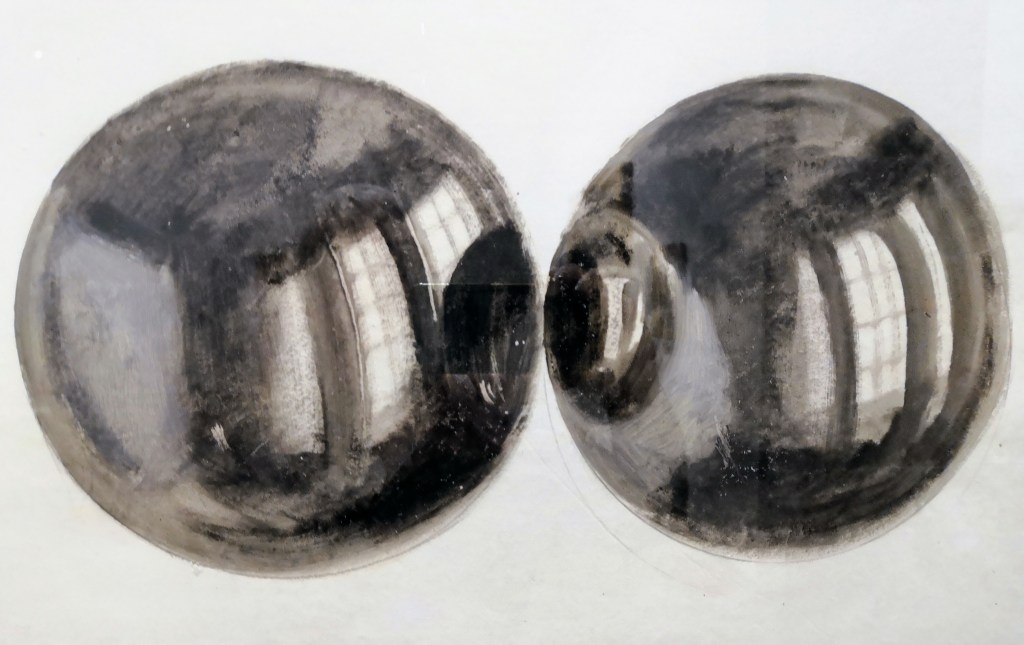
As I studied these sketches, I thought about the Professor of Perspective who sketched these diagrams in oil paint and graphite on paper as teaching aids for his classes so long ago. They were just so interesting. I think I would have liked you as a tutor Mr Turner.

PS. The image of Turner’s painting Yacht approaches the coast, at the top of the post, was not in the exhibition, but taken from a print in the book The Tate Gallery owned by my late father and passed onto me c 1960s.

 ARTISTRY
Thanks for these interesting thoughts, Vivienne. As always you have given me some things to think about. I love the Dubois-Fillet painting. And I agree Turner would have been an extraordinary teacher, though you might not want to disrupt him! These pictures are so simple and yet so evocative. It puts me in mind of Hopper, and the way he could make the simple play of light in an austere setting into an epic.
LikeLiked by 1 person
Great post Vivienne. I would love to see these paintings in person one day
LikeLiked by 1 person
“Professor of Perspective” – how interesting! Thanks for sharing your exhibition visit, Vivienne. 🙂
LikeLiked by 1 person
Thank you for this interesting insight. Turner, the teacher, is not really my first thought. How I would have loved to hear him speak. I went to a Turner exhibition in London many years ago and was absolutely mesmerized. Sublime.
LikeLike
Thank you for this post. I’ve always been fascinated by Turner’s work. But the light play in that painting by Dubois-Fillet is mesmerising.
LikeLike
Thank you for your comment. The Dubois-Fillet work is fantastic, I agree. One thing I love when drawing is to work on this kind of light play. Are you an artist by any chance? Regards Vivienne
LikeLike
Not quite Vivienne, I taught myself to draw about 3 years ago and haven’t put down the pen, pencil or paintbrush since. I’ve always loved wandering around galleries without realising why. We’re on the road a lot in our caravan so it’s a good chance for me to sketch those outback rusty sheds. Thanks for the inspiration!
LikeLike