
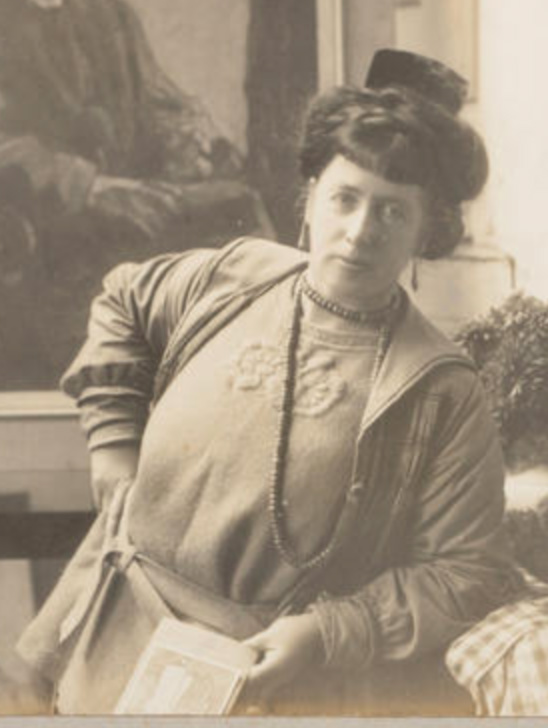
When I learned the Gow Langsford Art Gallery in Auckland was holding an exhibition of New Zealander Frances Hodgkins’ paintings and Mary Kisler, an authority on Hodgkins, was to be speaking with gallery owner John Gow about the artist, I booked in immediately. I arrived early, as many were expected to attend, and I strolled around the gallery taking photos until the rooms swelled with viewers. I, like so many New Zealanders, have been attracted to Frances Hodgkins’ art for a very long time. Being an artist, I admired her determination not to be pigeonholed by any one style. She was adventurous, and prolific, working in many styles and mediums throughout her life. And although Hodgkins moved to Great Britain as young woman and spent most of her adult life there, she is still very much admired and loved by us here.
I have chosen seven works from the total of eighteen displayed in the exhibition, which show the use of watercolour, gouache and charcoal.

This painting shows just how attuned Hodgkins was with watercolour at this stage of her career. To capture the emotion of two seated girls, yet create such fluidity of movement simultaneously – quite magic. It also shows she was not afraid of colour.

With Spring too, Hodgkins shows such a soft handling of brush, colour and line; a lovely profusion of shapes denoting the season. The arrangement is ordered and perfectly positioned on the cloth. A work of harmony.

This painting of Mrs Elizabeth Curtis, was done ten years later, in charcoal and watercolour. The line is free, loose and expressive, yet perfectly balanced. And serene. The paint is used sparsely, the mauve and green hues beautifully offset. The use of charcoal is fleeting too, using the flat edge of the charcoal to make wider marks, then flicking to the sharp edge to accentuate lines on the hat and vase. There is more abstraction indicated here, a change from the more realistic setting and style seen in the previous image.
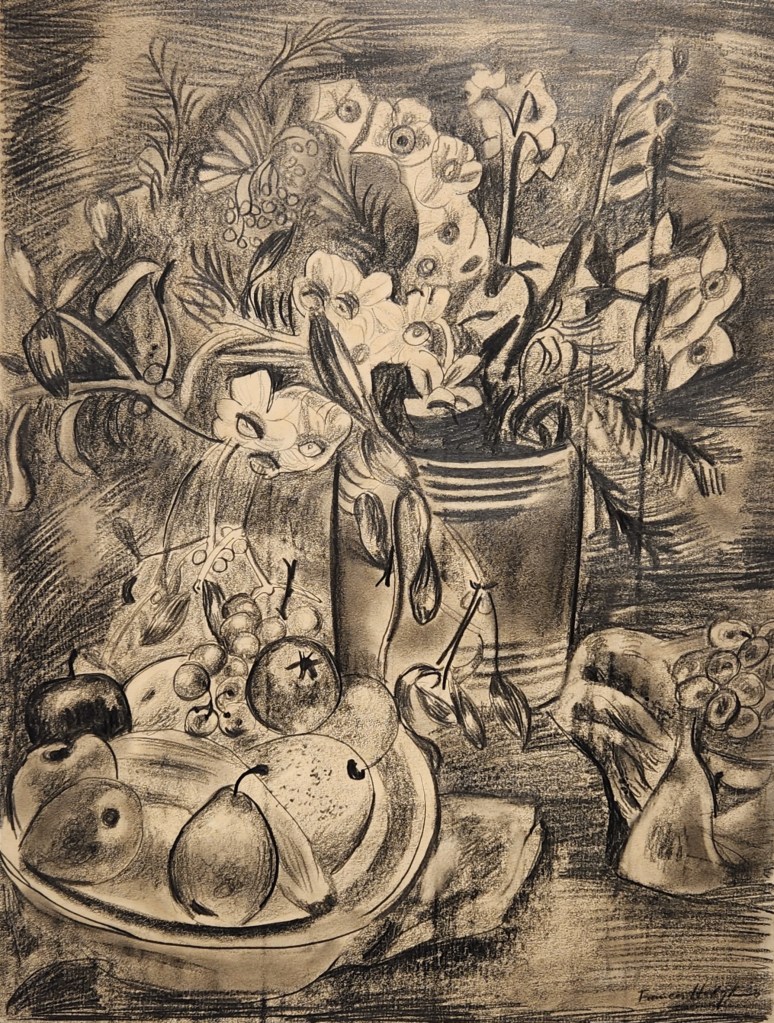
This drawing may represent still objects, but Hodgkins was able to instil a considerable sense of movement through the various tension she has applied to each stroke. The way she has evoked a darker background and created a movement, highlights the subject matter and doesn’t detract. She knows this medium, and makes it perform to her bidding. It is masterful!

This painting from c. 1932 is just a year on from the drawing above. This time gouache and watercolour are used on paper. Gouache is a thicker medium than watercolour, drying quickly, which enables more colour to be layered overtop and not bleeding into the underlay as watercolour does. It is a great medium for illustration. Here, Hodgkins has given this work a childlike quality. It would have made a perfect cover for a story with this boat as the main character.

And ten years on – 1942, Hodgkins produces this assemblage of shapes using gouache only. It is hard to see the thin layer of white wash in the background, which emits an eerie sense of times past.

And for the last image I’ve selected to bookend this post, I return to a floral watercolour painted just a year after the first image. Here, Hodgkins is using perspective differently, by foreshortening the bowl of flowers so the viewers sees the side and top of the arrangement. She has also given this image a transparency by including whimsical motifs which allude to an outside.
I wish to thank John Gow and the gallery, for enabling the New Zealand public to view more of Frances Hodgkins work, and to hear from Mary Kisler, who has broadened our understanding of the artist and her art.
To read more about Frances Hodgkins on my site, go to: More on Frances Hodgkins (2024) and An Artist who lived her dream (2019) And if you would like to see more images please go to: https://completefranceshodgkins.com
(I wish to explain that I have shown the images minus matts or frames, in order to present the art at its best, given the size limitations of this post).
 ARTISTRY
Such prodigious talent!
LikeLike
Hi. To be honest, I can’t say that her artworks knock me out. But I like a few of the ones in your article, especially Flowers In A Bowl.
LikeLike
Thanks for your comment. Flowers in a Bowl is rather lovely. At least she had a go at various styles. Some of us just stick to the tried and true.
LikeLike
Francis Hodgkins appears to be an exceptionally progressive woman. Such independence! The portrait of Mrs Elizabeth Curtis is quite remarkable. I can understand that Hodgkins is well-loved.
LikeLike
Hi Yvonne, thanks for your comment. Always good to have strong female artists to emulate.
LikeLiked by 1 person
Thank you for introducing me to another artist who likes to try different mediums and is not limited by any one style. I particularly like the more vibrant colours in the first painting as well as the expression on the girl facing the viewer. She appears to be very concentrated on the lantern. Of all the paintings you selected for this post, The Japanese Lantern remains my favourite. Cheers!
LikeLike
Always good to receive such a response. Thank you. I think the girls with a Japanese later was a crowd pleaser
It is charming.
LikeLike
Thanks for introducing me to these works, Vivienne. Beautiful. I am glad that artists can now thrive in New Zealand and Australia without necessarily having to transplant to the other side of the world, but perhaps it was her travels and challenges that helped make her the artist and person she was.
LikeLike
Hi Yvonne. I like the portrait very much too. It’s fleeting but quite lovely
LikeLike
Marvellous guide through this artist’s works. Lovely post, Vivienne!
LikeLiked by 1 person