If you’ve ever written a book and wish to see it published I am not about to deliver false hope about how easy it is. Naturally the writing comes first; or perhaps I should begin with the writing courses you may embark on as you shape and refine your skills. My creative writing study (for want of a better description) began after I’d scratched out the beginning of a first novel. I used those fifty pages to apply for a Masters in Creative Writing, and the opportunity to complete a novel draft. I was accepted, and got the degree, but that was just the start.
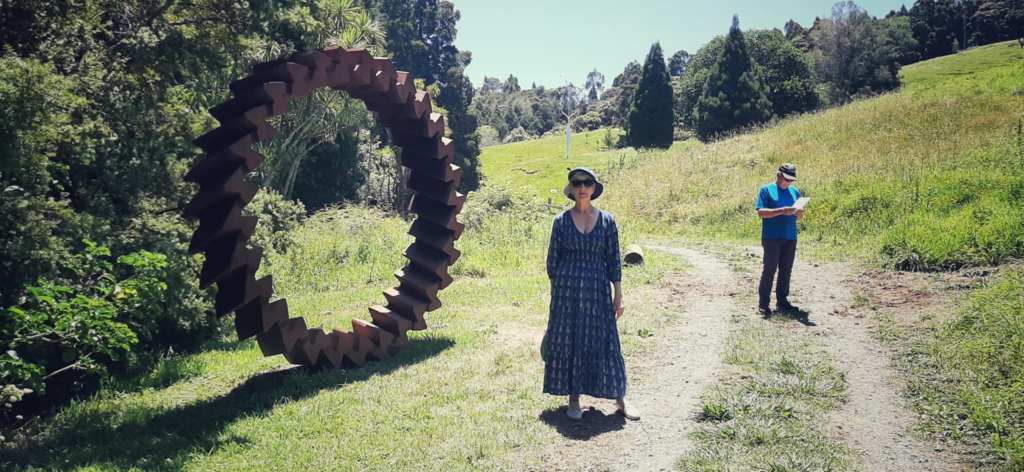
Yep, that’s me on my birthday (Covid positive day) looking every bit the rag doll I felt. I love this photo my daughter took, which resembles a still for a film I think. See, Kerry is there reading the script and feeding me cues! Fortunately I have come out the other side, and most pleased with myself. The main reason being is that I received the first proofs from the printers for my novel Mrs Forsythe not long after this photo was taken!
I had always thought myself a reader of fiction which relied on stories which were grounded, and didn’t take you to other realms, such as fantasy, or science fiction. I am speaking as my adult self here, for I certainly read and enjoyed fairytales as a child. Recently I attended the Auckland Writers Festival, and was lucky to hear Australian writer Trent Dalton speak. The Auditorium was packed, and the audience didn’t just wait until the end to show spontaneous applause. Afterwards I bought the title All Our Shimmering Skies, rather than Boy Swallows Universe, as the blurb on cover said it was better. Perfect timing as I was flying to Australia soon after and I was keen to get ‘stuck in’. It certainly was a page turner and I’d almost finished it before touchdown.
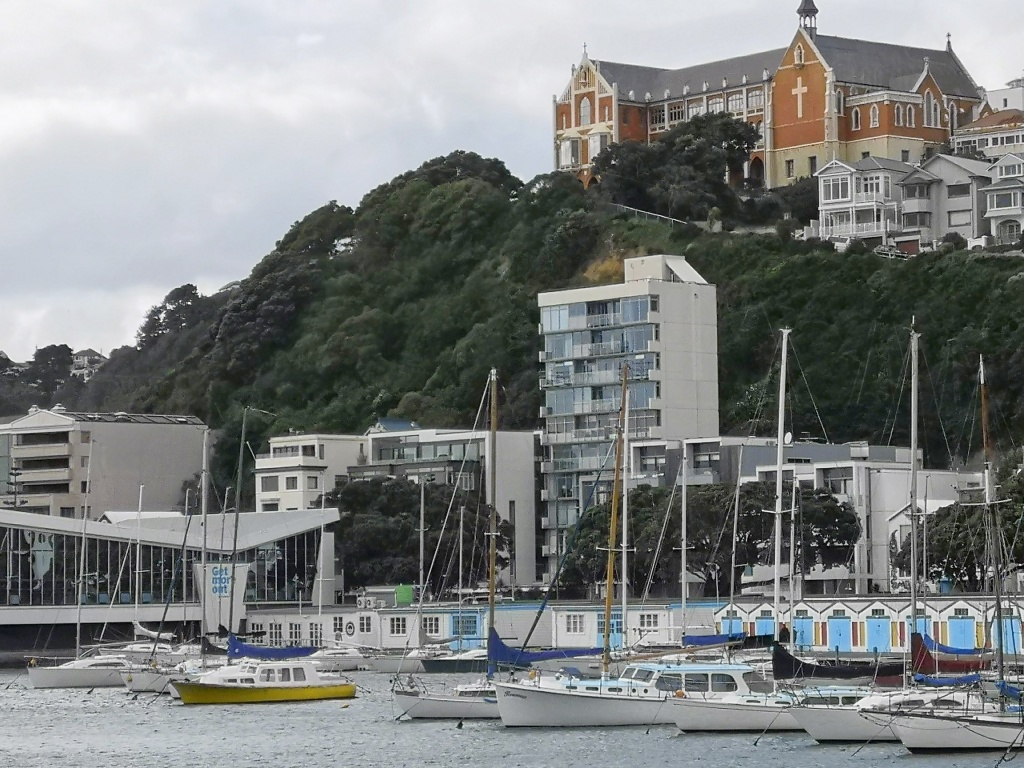
A recent photo of Oriental Bay, Wellington [photo V. Lingard]
Yes, the first draft is done, and now sits with the reader, though I would like to add a little more about what went into reaching that goal. Writers will know that it isn’t just a matter of coming up with a great idea and sitting at the computer and let the words fill the pages, easy peasy. There is the matter of plotting, and making a loose timeline. For me the setting was 1970s Wellington and the years my protagonist lived there. I sketch this out by hand rather than type it up, and mark where I think specific scenes, or events may occur. What was happening during those years? Research next, to top up my memory of these times. So much goes into this, for example: what movies were shown, what music was played, who was prime minister, what sports were popular, what programmes ran on the radio? You get the idea.
There is a reason I haven’t been churning out any posts recently, and it’s because I’ve been focussed on finishing my novel. It’s been a long road, sometimes smooth, often bumpy, as I squinted at my computer screen and squeezed out the words. How lovely it must be to write some people have said to me, and it is, don’t get me wrong, it’s a great creative thing to be making up a long piece of fiction. But it is hard work. I think I summed it up when my granddaughter gasped when I told her how long it had taken. I said, “I guess it’s a little like homework, it needs plotting, planning, and a lot of patience to work it all out.” My manuscript is not huge at 74,000, though enough I think, since it’s taken me two and a half years of my life to produce it.
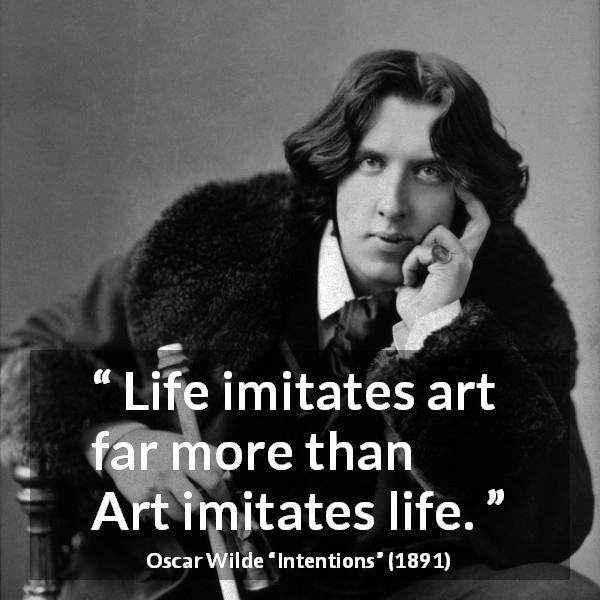
Mimesis is a word I’ll never forget, as it was written in capital letters on a whiteboard in blue, as the subject of my first ever writing class at university. I sat in the auditorium waiting for the lecturer to appear, wondering what on earth I was doing there, as I was a ‘mature’ student and didn’t have a clue what the word meant. I think after all these years I have got a handle on its meaning. It iswhen life is mimicked through Art and Literature. Yesterday I reversed this process, when my life happened to imitate literature – through inadvertently copying a character’s behaviour from the novel I am currently writing. The problem might be different: solo travel for my character, and swimming alone, for me, but the underpinning for both women is anxiety, and the desire to change.
Last week I had the pleasure of seeing my daughter Lara Macgregor perform in a play which was especially written for her and co-actor Mark Hadlow, by Gregory Cooper, writer and director. The play debuted at the Professional Theatre Company, which Mark Hadlow recently formed in Nelson – a brave and brilliant move given the current unstable nature of the performing arts industry in New Zealand. I was pleased that Mark brought the play to the Sky City Theatre Auckland soon after its debut giving many more New Zealanders the opportunity to see it.
Monty Soutar and the first book in the trilogy Kāwai (line of descent, lineage or pedigree).
Last week saw the Auckland Writers Festival very much alive in our city. I did not attend many events as the week was already flooded with other activities. I wish to write about one event though, of a discussion between Tracey Morrison (Te Arawa, Ngāi Tahu), a well-known New Zealand broadcaster, and Monty Soutar ONZM (Ngāti Porou, Ngāti Awa, Ngā Tai ki Tāmaki, Ngāti Kahungunu). They talked about his latest book Kāwai, a shortlisted novel for the recent Ockham New Zealand Book Awards. Monty has received commendations and awards for his scholastic achievements and work to raise the understanding of the history of Māori in many fields, and Kāwai is his first venture into writing fiction. If you are thinking that the discussion about his book might prove a little dry, or boring, you’d be wrong.
Three weeks ago I was asked to speak alongside author Caroline Barron, at the Auckland branch of New Zealand Society of Authors meeting. I was intending to write a short post on this earlier, but life, again, got in the way. Last week I was frantically writing as much on my novel as possible before visitors arrived, which meant I neglected everything else. And then, this week came around, and suddenly it was ‘all hands on deck’ to clear out our bedrooms as new carpet was due to be laid Thursday. The bedrooms are clean and vacated and the rest of the apartment looks a mess!
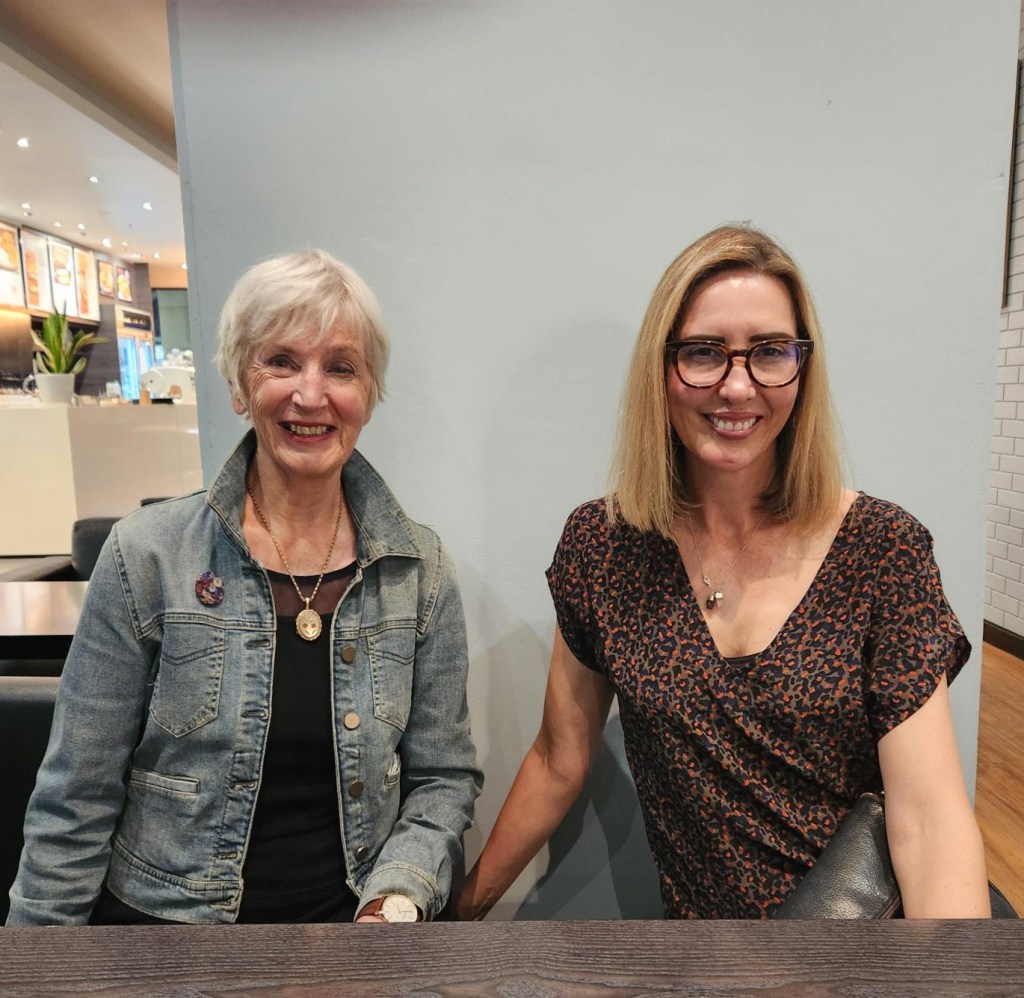
Now, here I am finding time to write a few words about the talk I mentioned at the start. Caroline Barron and I have written both memoir and adult fiction, and were asked questions by the chair Maria Gill, as a joint interview, about the similarities and differences in how we approached the process of writing in each of these genres. Maria, posed interesting questions, such as: What’s the relationship between honesty and good storytelling? Often Caroline and I said virtually the same thing, swapping the mic from one to the other to say our piece. With this question, I said “Honesty for me was being authentic; staying true to the ‘character’ in the memoir and presenting facts accurately.” This then led to the discussion of how important research is writing in either genre. We both agreed that research was essential for both.
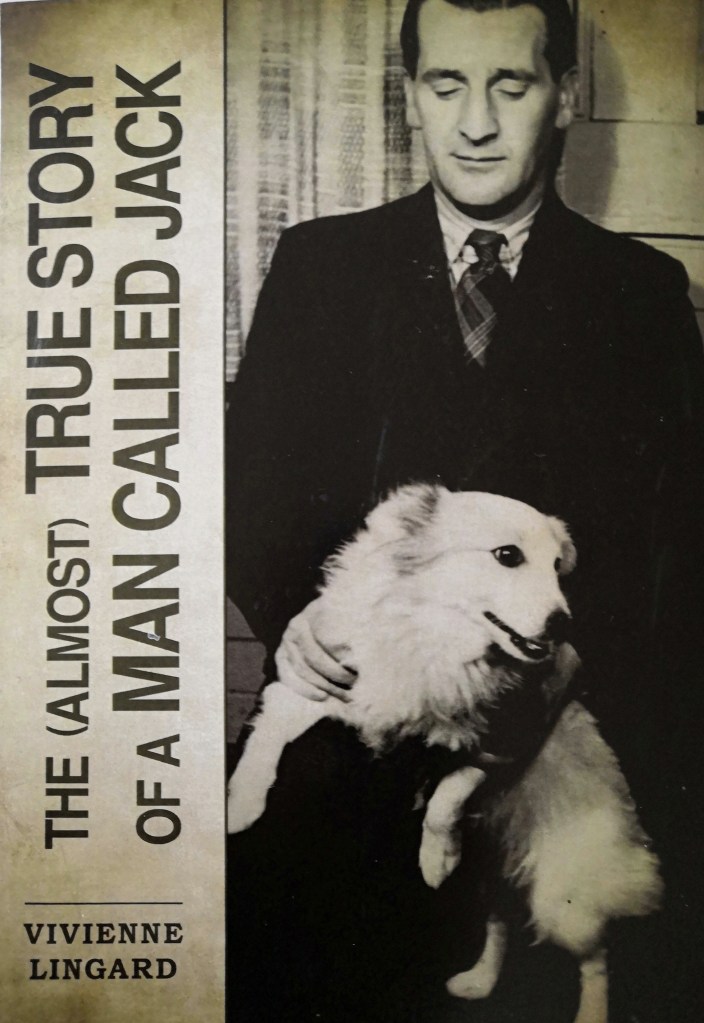
The memoir of my father
We were asked if there were differences in the way we structured each form. I start with a timeline, which places scenes, or ‘happenings’ along the line, with the year each takes place. Another question was, how do you approach the task of deciding what to include or leave out in your memoirs or novels? And the ethical implications of writing about real people. With my memoir, I began the narration from the time I could recall events vividly, and ended with the death of the main subject. I stayed as true to all the main characters as was possible, and fiddled more with what occurred when. Again, research is required, such as; what politician was in power, what songs and programmes were popular. Plus the games, foods, sweets…
My book of short fiction
When writing about real people in memoir, it is necessary to let them know that you are writing something which may include them, but to soften this somewhat, I fictionalised the names of all my characters in the book. My family, which were the main group in my memoir, knew that the children were based on them. I had only two siblings to deal with here, and they were comfortable with my decisions (I believe), as I consulted them throughout. With fiction, I have sometimes based a character on someone I have observed, not actually known, whose characteristics, physicality, hair style or demeanour has taken my attention. But again, the characters; the setting and details of place need to be authentic, down to their mannerisms, quirks, speech patterns, etc. There’s that word again and one I can’t emphasis enough when it comes to writing interesting work which will capture a readers imagination.
It was great to speak alongside Caroline Barron that night. The audience liked what we had to say too; even saying it was a ‘stimulating’ session. Thanks Maria for asking us along.
Katherine Mansfield (1888-1923) would be New Zealand’s best known writer of the short story. Thousands of students would have studied her in university; others would have read her just because she writes so well. I belong to both those camps. Katherine was born Kathleen Mansfield Beauchamp into a prosperous family, who lived in Tinakori Road, Wellington. She was bright, gifted in music and writing from an early age. But she felt a misfit in her family, thought her home ‘dull and claustrophobic’, and once she’d visited London as a teenager, yearned to live a liberated, and bohemian life, preferably abroad. She left for London on her own aged nineteen, became the writer she dreamed of being and never returned home. It is testament to her skill as a writer that we are still reading about her a hundred years after her death, and it is the book written to mark this centenary I especially wish to write about.







 ARTISTRY