The penultimate session

Last week I started to work on an invented background for my painting, as the room lacked ambience. Once home I spent some time trying to improve on the colours and build more interest to the painting as a whole.

First thing was to correct the position of the right leg. I was still struggling to get the thickness of my paint as I wanted, and it always seemed to come out too thin even with medium. Never mind I told myself, I can always let it dry and add more layers.

And so, that’s what I did. At least by the time I’d put the canvas aside I could say that I almost liked it. But there was a way to go.

Continue reading

From sketch to canvas process

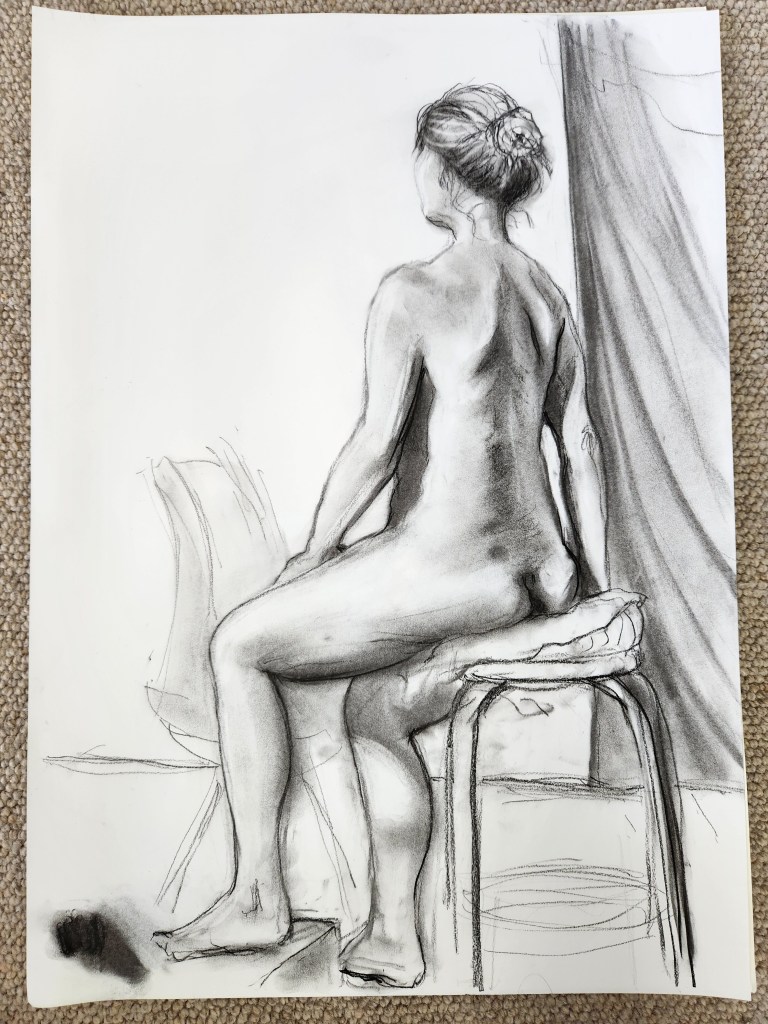
Continuing on from last week, when I showed you the charcoal sketch (see above) which I would be transposing onto an A2canvas. As I am going to take you through that process I thought it would help to include it here as this is the pose I shall continue to work from.

Continue reading

The next phase: sketching towards a painting

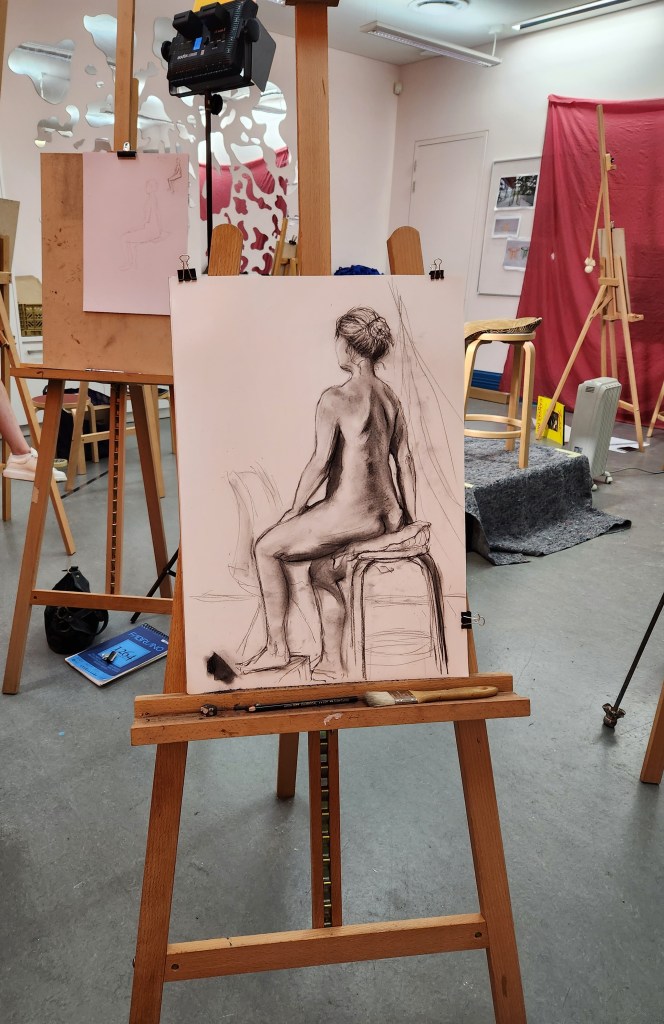
Week Three. In this session we were to work on A2 paper, using pencil or charcoal for our preparatory sketch. No photocopies this week. The model Lulu is similar in build to the figure we had copied in Goldie’s work – the idea being, we were told, was to execute a painting in tones similar to the one we had copied. But first, the pose needed working out, and so a few minutes were spent moving a stool, arranging a cushion, and having the light in an appropriate position to suit both the model and the class. We would be working with this same pose for three weeks. Hard on the model I thought.

I was pleased to be using my favourite drawing medium for this stage. Charcoal is such a forgiving medium and I just love the nuance of tone it allows one.

Continue reading

The last stages

I worked a little on the painting yesterday, and this is the image here. I left it to dry overnight and returned to it today.

I will work on it a little tomorrow and hopefully it will be done.

I should have waited until the paint had dried to take the photo as every brush stroke is laid bare (unintentional pun).

I have decided to trim the image and focus on the model and not include the barely discernible chair at the periphery of the scene in the original. I think this format works better in my view.

Continue reading

The work in progress: week two

Last week’s underpainting

Following last week’s effort, I thought a good deal about how I would approach the second class, realising there was a chance of not been offered any specific way in how to apply oil paints. I decided to progress my painting by instinct; it wasn’t as if I haven’t drawn from life, and although my painting history has revolved around fiddling with watercolour, I have used acrylics before. And, I do know a reasonable amount about colour, albeit using pencils rather than paint. During this session we were encouraged to go and view the original painting again. It was difficult to see the actual paint strokes as it was behind glass but we did agree the painting was lighter in tone and showed the colour more effectively than the photocopies we were working from.

Continue reading

Becoming a student again

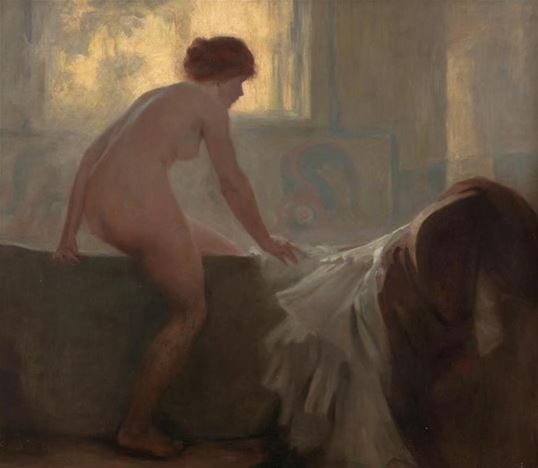
by Charles Goldie (NZ artist 1870-1947)

On Saturday I attended my first of six art classes at the Auckland Art Gallery in painting the figure using oils. It’s been over twenty years since I last tried oils, and had all but forgotten what to do, so was keen to gain some new skills. The above image is the one the class was to attempt to paint from; presented to us in photocopied form, the colours even more subdued than the original image shows. We were also handed a slightly smaller version with a grid pattern superimposed. I looked at the grid, knowing it was often used for beginners learning to draw proportions. I hadn’t used one ever for sketching the nude. However, I was keen to do what everyone had been instructed to do, and set about marking up a piece of paper with the same grid proportions.

Continue reading

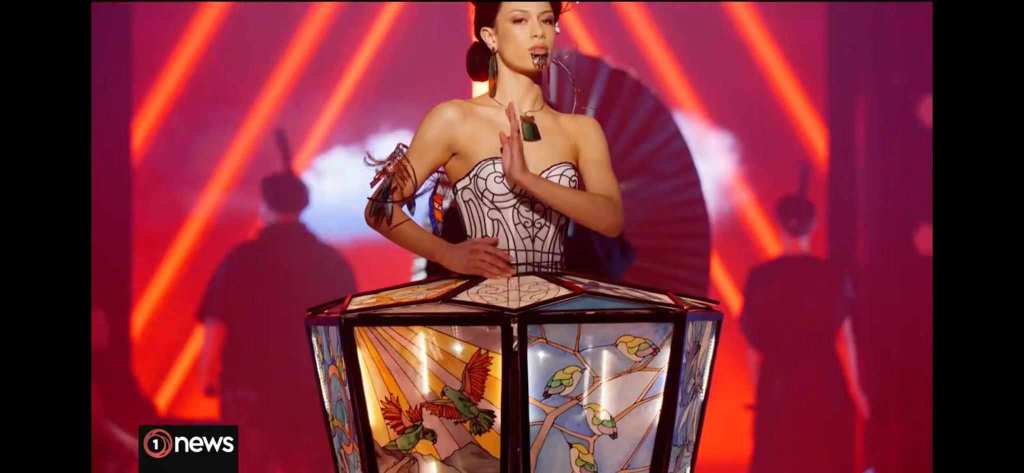
A special interest in this year’s World of Wearable Art

Te Ao Mārama entry by Fran and Lauren Kidd
The World of Wearable art show is a New Zealand invention conceived by Dame Suzie Moncrieff, Nelson. The fashion extravaganza was shown in her hometown from 1987 until 1990, when its gathering popularity demanded a shift to the capital city, Wellington. WoW had become a phenomenon. In Dame Suzie’s words, she describes what WoW personifies for her:

“To take art off the wall and out of static display. To adorn the body in wildly wonderful ways. To celebrate creativity in a lavish and unique on-stage spectacular that will inspire us all.”

And inspire it certainly does, attracting entries from all over the world, which have audiences looking forward to the annual event with much anticipation and excitement. Especially this year.

Continue reading

Occasion markers

Great Stupa at Kathmandu, Nepal

I love the way something you buy, whether travel mementos, or presents received or given, stand as markers in one’s life. Take the ceramic teapot I’ve decided to sketch (below), which was the first present I gave my husband not long after we’d met. It was April 1992, and I had the great fortune to travel to Nepal on a 29 day trek with three other women from New Zealand; such a fantastic experience. (Link above takes you to a post from a few years back). The day I returned to my hometown, I helped out a friend with an exhibition opening at our art gallery, and there Kerry was, also helping out. We chatted for ages before parting ways, thinking maybe we just might get to chat some more – sometime. And, surprise! surprise, by the end of the year we were chatting a lot.

Continue reading

More on Frances Hodgkins

Frances Hodgkins working from her studio in Croft.

A few months back I was in Dunedin, and visited their very good public art gallery. I was thrilled to find an exhibition of works by New Zealander Frances Hodgkins I’d not seen before which were all completed in England. She was in London in 1939 at the start of the war, and for safety reasons I imagine moved to the Dorset countryside. She lived in Corfe Castle village on the south-west peninsula, where she remained until 1945. She was able to move a little between the small villages, and set up a small studio in nearby Croft. Because of the war-time restrictions foisted upon her, she set about documenting the rural life of small villages and communities in her paintings. She was often forced to stay indoors, whether through atrocious weather, or air raids and coastal gunfire. It is testament to the dedication she gave to her art practice that she was able to work under such conditions.

Continue reading

What kind of reader are you?

I had always thought myself a reader of fiction which relied on stories which were grounded, and didn’t take you to other realms, such as fantasy, or science fiction. I am speaking as my adult self here, for I certainly read and enjoyed fairytales as a child. Recently I attended the Auckland Writers Festival, and was lucky to hear Australian writer Trent Dalton speak. The Auditorium was packed, and the audience didn’t just wait until the end to show spontaneous applause. Afterwards I bought the title All Our Shimmering Skies, rather than Boy Swallows Universe, as the blurb on cover said it was better. Perfect timing as I was flying to Australia soon after and I was keen to get ‘stuck in’. It certainly was a page turner and I’d almost finished it before touchdown.

Continue reading