What research can reveal

I have been working on a ‘memoir’ in pictures based on my younger years and have been wrestling with just how I wished to present this. You may have seen my last post, which shows some progress with the sketches, and although I think I know what I wish to portray, I am still looking for how I shall achieve this. Naturally I have been thinking back to early memories, and particular things which have been salient throughout my life, and helped shaped my adult self. Books certainly. So, yesterday I looked up the names of books which I remember loving in my Primary school years. Five stood out.

‘What Katy Did’ series, by Susan Coolidge (American), Seven Little Australians by Ethel Turner (Australian), My Family and Other Animals by Gerald Durell (British), The Silver Sword by Ian Serrailier, (British) and The Story of My Life, by Helen Keller (American).

Continue reading

Well, there is a little progress

Original rough, left side of double page spread

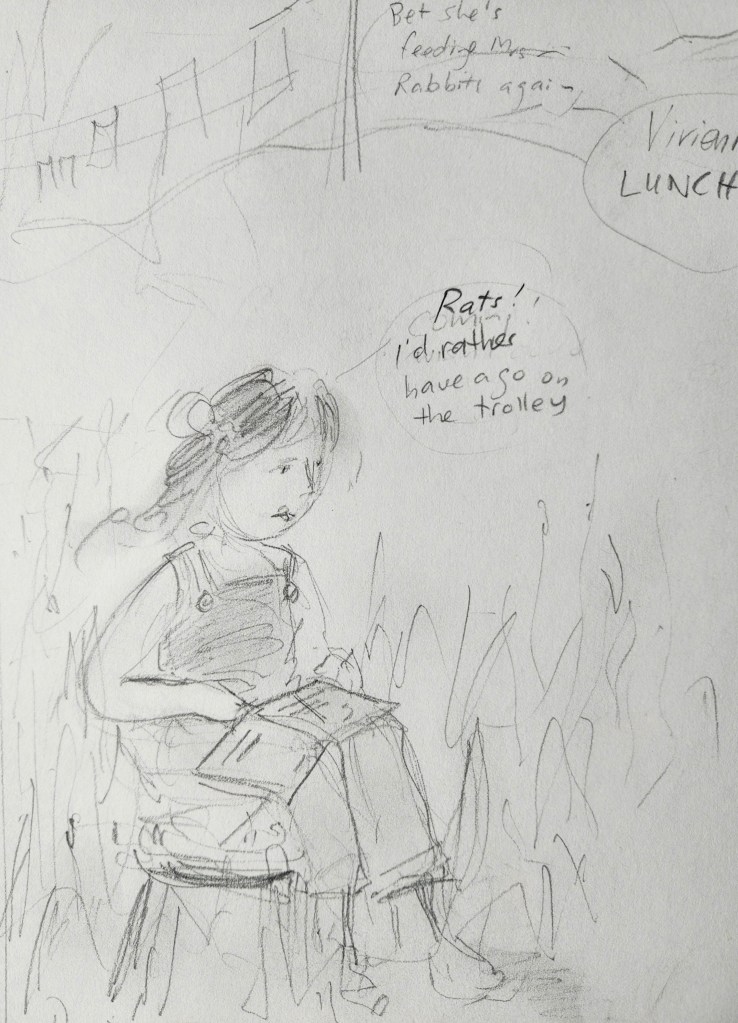
Last time I talked about my memoir with pictures, I showed a few pencil sketches of some pages I had nutted out. I have now sketched more pages, attempting to make a storyboard of the tales I wished to tell, or portray. This bit was easy. I love sketching in pencil and plotting scenarios based on my experiences when young, that was no trouble what so ever.

I studied other graphic novels to get a feel with how I wanted mine to look: a mixture of double pages in colour or black and white, and several pages with smaller images, as you might see in a comic, with speech bubbles etc., But then, I decided I should do at least one trial page in full colour as I imagined the larger pages should look. But, what medium to use?

Continue reading

Looking at light on form

Willow charcoal & charcoal pencil, 1996

I went to my first Life Drawing classes aged fourteen with my dad. My brother and sister also attended at various times too. Dad was passionate about art and thought one of his children might catch the bug. However, I was the only one who ended up at art school, where I continued to sketch the figure. It was something I loved doing then, and have continued doing from time to time, ever since.

The above sketch was part of an exhibition of my figure studies completed that year. I hired a model, and worked in a studio above my garage to produce the work. It was great to have a comfy sofa the model could relax in, which resulted in many nice long poses. All the work sold, which was good, but when I realised I wished to keep one (the above image) for myself, on enquiry I found my agent had sold it that very day. Lucky I had taken a photo.

Continue reading

Off to Cologne – The Cathedral & Museum Ludwig.

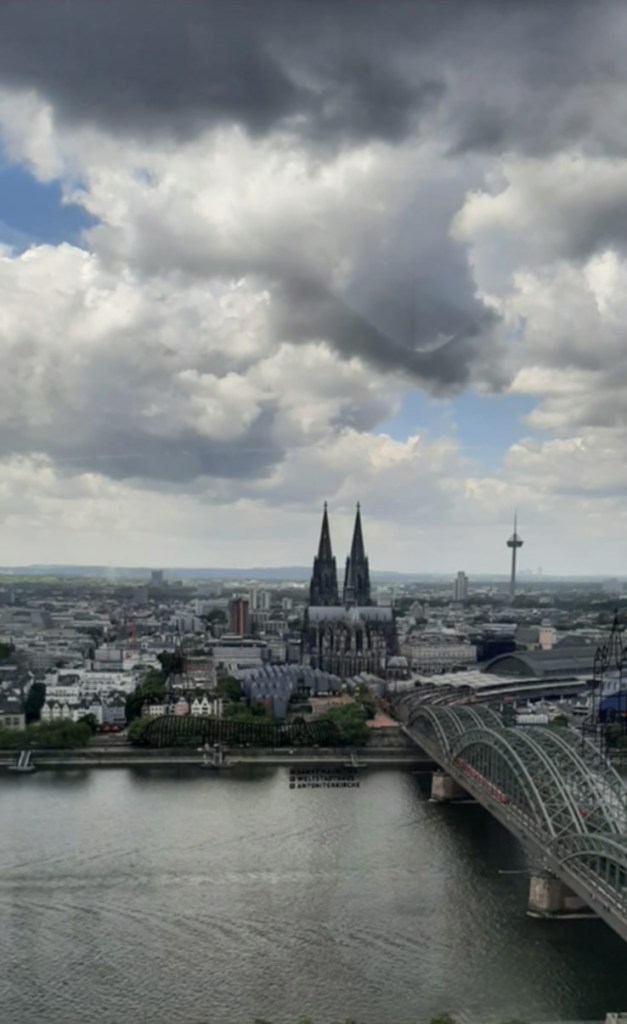
The spires of the Cathedral under a moody sky

We continued our cruise through the night from Dordrecht, with me dreaming of the wonderful windmills we had seen in Kinderdijk that day. The ‘ship’ docked in Monheim at approximately 9am on Friday. Soon after we were on a coach and heading into Cologne where we would begin our walking tour. Our destination – the Cathedral. We needed to cross the bridge, you see in the photo, but so did zillions of others, and rather like we found in Amsterdam, the pedestrians had to fight with cyclists for the same space. I was surprised when the tour guide told us that we would likely be shouted at, or even sworn at by cyclists! And although I was never sworn at, the walk across the bridge was certainly memorable.

Continue reading

Off to Cologne – The Cathedral & Museum Ludwig.

The spires of the Cathedral under a moody sky

We continued our cruise through the night from Dordrecht, with me dreaming of the wonderful windmills we had seen in Kinderdijk that day. The ‘ship’ docked in Monheim at approximately 9am on Friday. Soon after we were on a coach and heading into Cologne where we would begin our walking tour. Our destination – the Cathedral. We needed to cross the bridge, you see in the photo, but so did zillions of others, and rather like we found in Amsterdam, the pedestrians had to fight with cyclists for the same space. I was surprised when the tour guide told us that we would likely be shouted at, or even sworn at by cyclists! And although I was never sworn at, the walk across the bridge was certainly memorable.

Continue reading

More on Frances Hodgkins

Frances Hodgkins working from her studio in Croft.

A few months back I was in Dunedin, and visited their very good public art gallery. I was thrilled to find an exhibition of works by New Zealander Frances Hodgkins I’d not seen before which were all completed in England. She was in London in 1939 at the start of the war, and for safety reasons I imagine moved to the Dorset countryside. She lived in Corfe Castle village on the south-west peninsula, where she remained until 1945. She was able to move a little between the small villages, and set up a small studio in nearby Croft. Because of the war-time restrictions foisted upon her, she set about documenting the rural life of small villages and communities in her paintings. She was often forced to stay indoors, whether through atrocious weather, or air raids and coastal gunfire. It is testament to the dedication she gave to her art practice that she was able to work under such conditions.

Continue reading

Pink roses can spell love too

Featured

Roses by JFL Fowlds

If I hadn’t admired a friend’s post last week, where he posted a fine painting of flowers, I may not have thought of writing about the painting I have sitting on my study wall. There is a history to this painting of pink roses in an old-fashioned vase (circa late 1940s), which was possibly done as a study from an image in a book, or calendar. The book may have well been a ‘how to paint’ variety, showing step by step processes. My father clearly studiously emulated the image – whatever its provenance. The sketch, painted in watercolour on a primed piece of cardboard, was admired by those who saw it, including myself and siblings. I was a teen when my father died, and any art of his carries special meaning.

Continue reading

What lay behind the biscuit barrel?

Featured

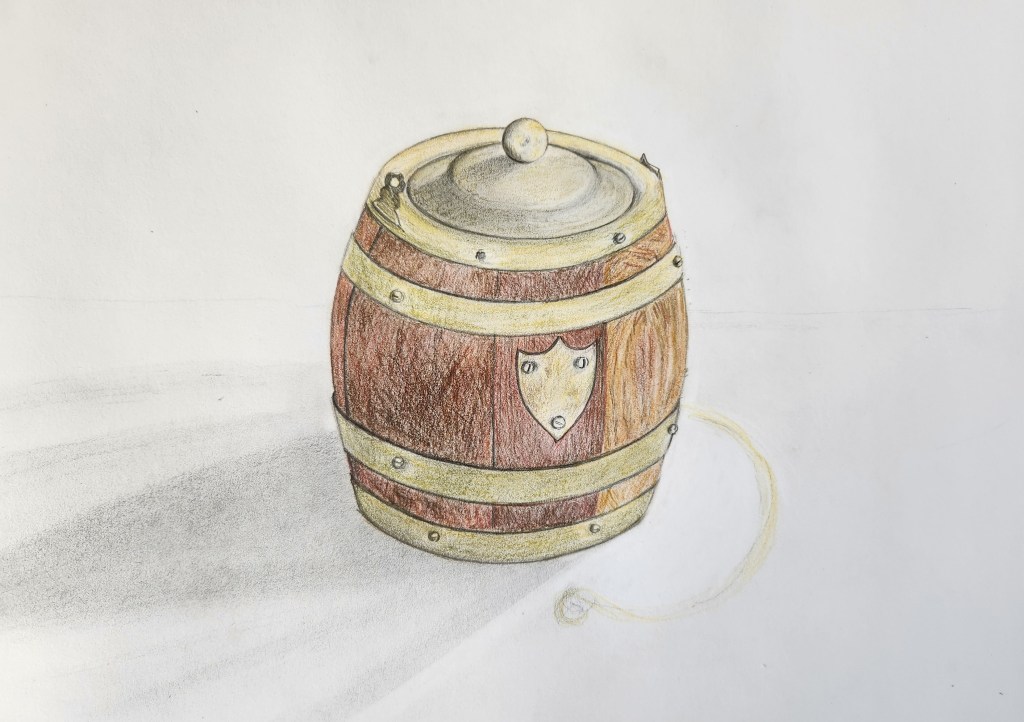
Considering the handle

Last post I was dealing with a crook back. Improving now, thank goodness. I was also recovering from a cataract operation, and that I found even less conducive to looking at a screen for writing, or a sketch pad for sketching. However, I can exercise again, and can see without peripheral bright light flashing, finally enabling me to do the post I’d planned. For two or more weeks I’d thought about drawing this old wooden barrel, which is a perfect container for loose tea. It did start its life as quite a different object which I’ll get to by and by.

Continue reading

An interesting fact about Turner

Featured

Yacht approaches the coast: JMW Turner c 1842

Last week I visited the Auckland Art Gallery Toi o Tamaki to see the Light from Tate: 1700s to Now exhibition. This was an interesting collection, as it featured many facets of how light was and is represented in art. The work stretched in time from the 18th Century to the present day. The first paintings were from Joseph Mallard William Turner, and anyone who has been fortunate to visit the Tate Gallery in London, will have viewed many of his famous landscapes with vast skies filled with light and texture. And for all that I enjoyed the whole show, I wish to write about a few paintings which appeal to the type of work I like to do.

Continue reading

A writer’s treat

Featured

Monty Soutar and the first book in the trilogy Kāwai (line of descent, lineage or pedigree).

Last week saw the Auckland Writers Festival very much alive in our city. I did not attend many events as the week was already flooded with other activities. I wish to write about one event though, of a discussion between Tracey Morrison (Te Arawa, Ngāi Tahu), a well-known New Zealand broadcaster, and Monty Soutar ONZM (Ngāti Porou, Ngāti Awa, Ngā Tai ki Tāmaki, Ngāti Kahungunu). They talked about his latest book Kāwai, a shortlisted novel for the recent Ockham New Zealand Book Awards. Monty has received commendations and awards for his scholastic achievements and work to raise the understanding of the history of Māori in many fields, and Kāwai is his first venture into writing fiction. If you are thinking that the discussion about his book might prove a little dry, or boring, you’d be wrong.

Continue reading