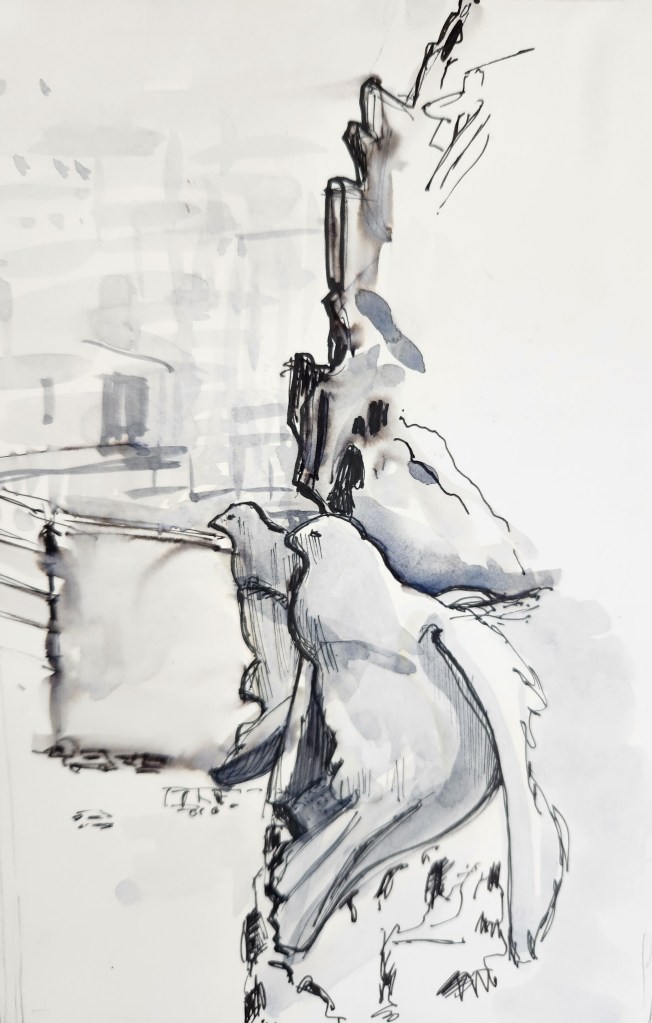
Last week I was reminded of my sketch trip to Spain in 2019, and I went looking for the sketchbook I’d used at the time. Previous to leaving, I’d joined a travel sketching group, and in preparation we were asked to choose something to sketch from a favourite place we’d visited. So I chose a photo taken twenty years earlier from the cathedral Sagara Família in Barcelona.
I was high in a tower which overlooked the city and focussed on the sculptured doves in front of me. I used water-soluble ink for the foreground. It’s wise not to load the brush with too much water when you pick up the ink pigment. I used a diluted watercolour for the background.
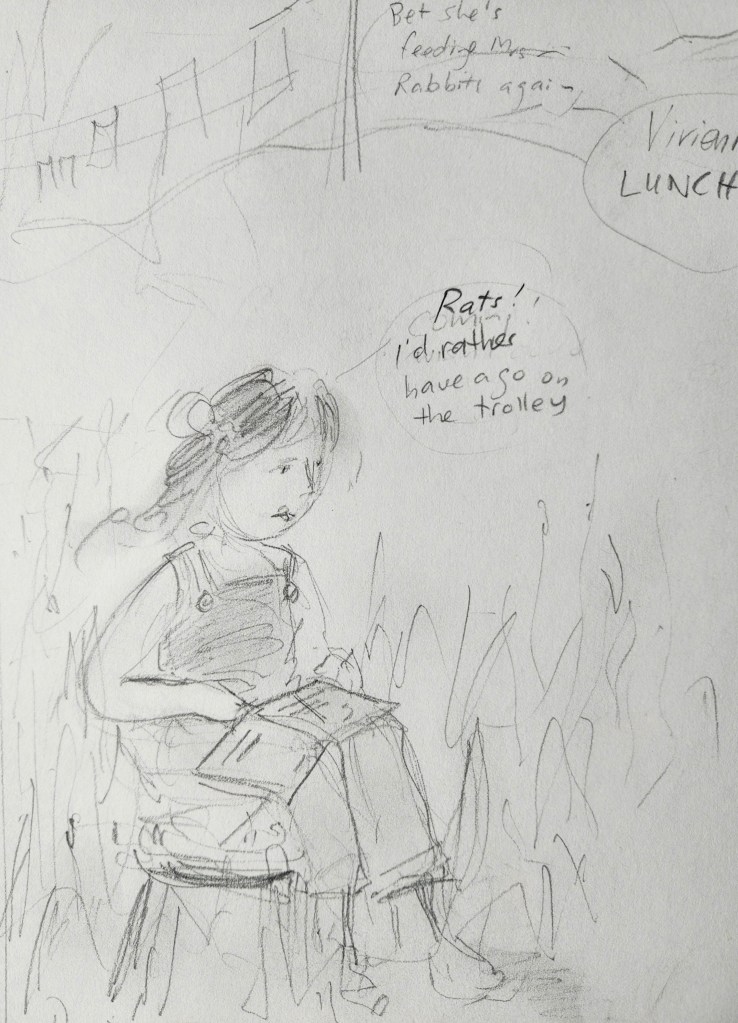
Last time I talked about my memoir with pictures, I showed a few pencil sketches of some pages I had nutted out. I have now sketched more pages, attempting to make a storyboard of the tales I wished to tell, or portray. This bit was easy. I love sketching in pencil and plotting scenarios based on my experiences when young, that was no trouble what so ever.
I studied other graphic novels to get a feel with how I wanted mine to look: a mixture of double pages in colour or black and white, and several pages with smaller images, as you might see in a comic, with speech bubbles etc., But then, I decided I should do at least one trial page in full colour as I imagined the larger pages should look. But, what medium to use?
In last week’s post, I promised that you would see another sketch. Well, I did keep my word, and here it is, taken from a photo I took of the Cologne Cathedral on my recent travels. If you have followed my site, you will know I love sketching clouds, and that is why this sky over the Cathedral appealed to me. Nothing I like better than a great mass of brooding cumulus to get me going with the pencils.
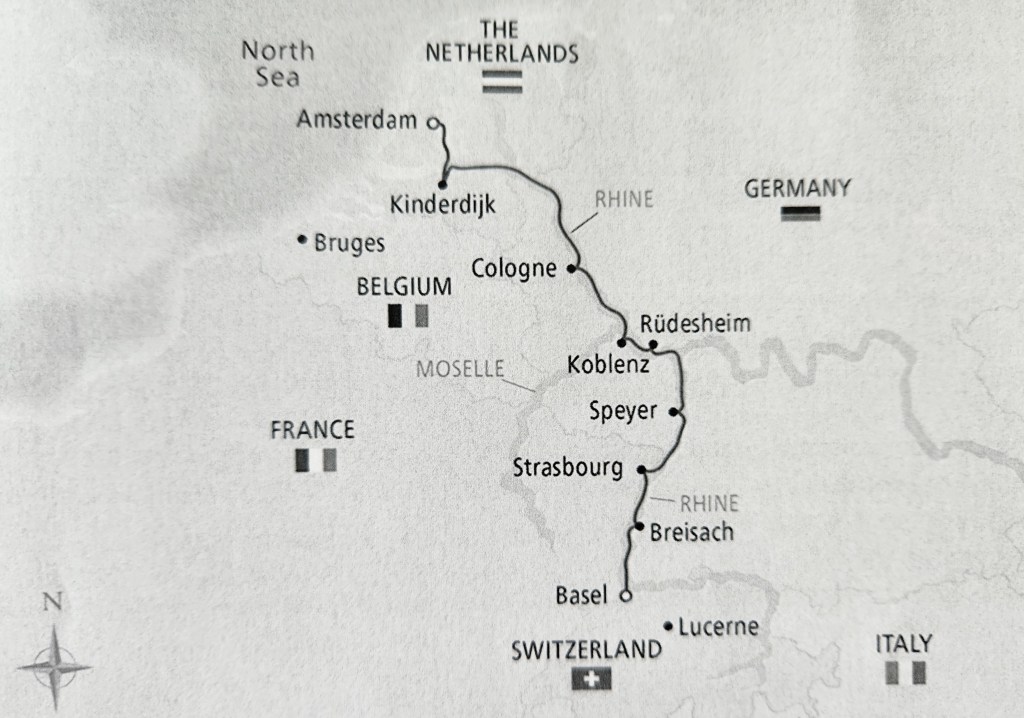
After joining the ship, we spent the first afternoon settling in to our cabins (named staterooms on board), and prepared to meet staff and other passengers whose company we’d be among as we made our way from Amsterdam towards Basel, the culmination of our river cruise. As we imagined, the food and wine was of a high standard and helped us enjoy the eight days on board very well. Added to this was a crew member, who doubled as a great pianist and singer, whom we listened to throughout the evenings pre and post dinner. There was a rundown by the Programme Director on the following days’ events each day, with guided walks included in overall cost of cruise, and other excursions which cost more. But, if you have trouble sleeping, I suggest you do such a cruise as I, an erratic sleeper, cannot recall such a sound sleep as we moved through the night, and docked without my hearing a thing.
When I learned the Gow Langsford Art Gallery in Auckland was holding an exhibition of New Zealander Frances Hodgkins’ paintings and Mary Kisler, an authority on Hodgkins, was to be speaking with gallery owner John Gow about the artist, I booked in immediately. I arrived early, as many were expected to attend, and I strolled around the gallery taking photos until the rooms swelled with viewers. I, like so many New Zealanders, have been attracted to Frances Hodgkins’ art for a very long time. Being an artist, I admired her determination not to be pigeonholed by any one style. She was adventurous, and prolific, working in many styles and mediums throughout her life. And although Hodgkins moved to Great Britain as young woman and spent most of her adult life there, she is still very much admired and loved by us here.
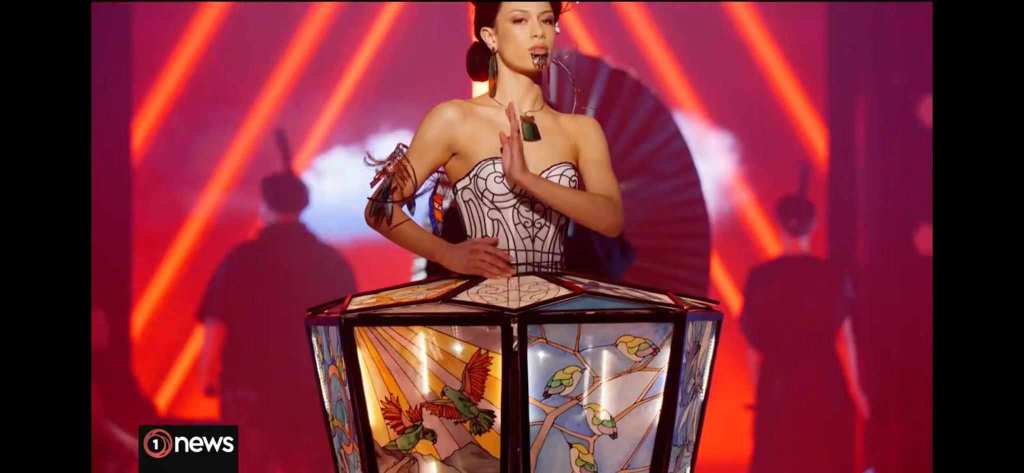
The World of Wearable art show is a New Zealand invention conceived by Dame Suzie Moncrieff, Nelson. The fashion extravaganza was shown in her hometown from 1987 until 1990, when its gathering popularity demanded a shift to the capital city, Wellington. WoW had become a phenomenon. In Dame Suzie’s words, she describes what WoW personifies for her:
“To take art off the wall and out of static display. To adorn the body in wildly wonderful ways. To celebrate creativity in a lavish and unique on-stage spectacular that will inspire us all.”
And inspire it certainly does, attracting entries from all over the world, which have audiences looking forward to the annual event with much anticipation and excitement. Especially this year.
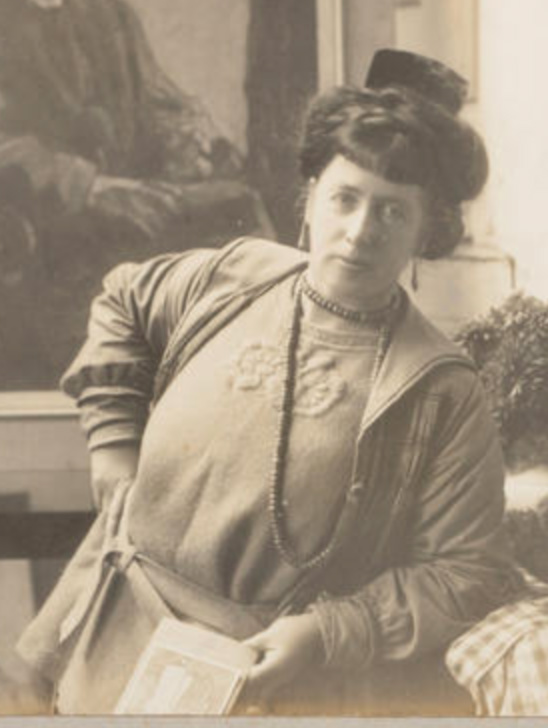
Frances Hodgkins working from her studio in Croft.
A few months back I was in Dunedin, and visited their very good public art gallery. I was thrilled to find an exhibition of works by New Zealander Frances Hodgkins I’d not seen before which were all completed in England. She was in London in 1939 at the start of the war, and for safety reasons I imagine moved to the Dorset countryside. She lived in Corfe Castle village on the south-west peninsula, where she remained until 1945. She was able to move a little between the small villages, and set up a small studio in nearby Croft. Because of the war-time restrictions foisted upon her, she set about documenting the rural life of small villages and communities in her paintings. She was often forced to stay indoors, whether through atrocious weather, or air raids and coastal gunfire. It is testament to the dedication she gave to her art practice that she was able to work under such conditions.
This year has been one of friends’ dealing with difficult health issues, and deaths, and I was very much affected when learning of each. Just two weeks ago, we were set to holiday on Vancouver Island, and were looking forward to this, when we learned a brother of Kerry’s had died following a long illness. That same day we learnt the health prognosis for a very old friend in Melbourne was far from great. Instant panic, as we cancelled hotel bookings and postponed the Canada flights, while Kerry booked to attend the funeral down south, and we booked another flight for Melbourne a few days later. We had made the right, and best decisions we believe. With other family living in Melbourne we shuttled between various houses, and the 10th floor suite in the CBD where we were based.
But our main purpose in Melbourne was to see our unwell friend. He has been very busy putting together a volume of his poetry over the past weeks, which had been published and arrived in time for our visit. So good to know that he had this positive project to focus on throughout his treatment, for it has kept his spirits up, that’s for sure, and we are now very pleased to have his book. We enjoyed our time with our friend very much and were so pleased to have moved our holiday plans to later in the year.
A day after our return I learned my brother had fallen and broken his femur, and was due to be operated on in a few days’ time. The operation was done, his hip pinned and he was transferred to the hospital near his home to recuperate. The following day I heard he was in ICU on oxygen and given strong antibiotics for the pneumonia he had contracted. Now, this is when I had to dig deep, to find something that might help me relax and lift my spirits. So, first I did what I know always helps me, and that is to walk. Look to the sky, the trees, the birds, say ‘hi’ to strangers that kind of thing. But once home I didn’t feel like doing anything, but did plan a project for the next day, a sketch.
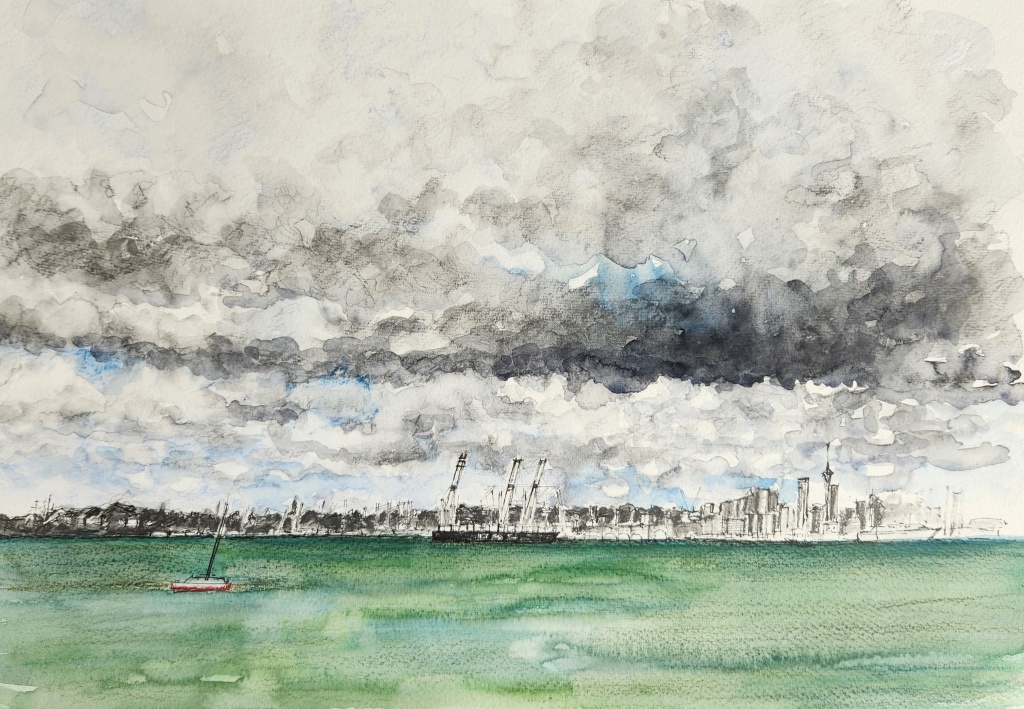
Another view to the Auckland CBD and Devonport naval base.
I heard my brother was improving today and that was the incentive I needed to finish my sketch. The mediums used: water-soluble colour pencils, ink, watercolour, and graphite. PS, the small brown ferry building (centre) was once one of the tallest buildings the waterfront!
I hope you like the sketch Bob (brother) and Barry (friend).
I sat down to begin a pencil sketch this morning, but was diverted by some cloud drawings I found in the sketch pad, so … I decided to put these together for this week’s post. Just a brief description of the mediums used, and not so much of a story this time. The top six sketches are from the Devonport area near my home, the seventh sketched on Waiheke Island, and the eighth done in Port Douglas Australia.
I usually sketch out the scene quickly, returning to fill out detail. I so love sketching clouds.
If I hadn’t admired a friend’s post last week, where he posted a fine painting of flowers, I may not have thought of writing about the painting I have sitting on my study wall. There is a history to this painting of pink roses in an old-fashioned vase (circa late 1940s), which was possibly done as a study from an image in a book, or calendar. The book may have well been a ‘how to paint’ variety, showing step by step processes. My father clearly studiously emulated the image – whatever its provenance. The sketch, painted in watercolour on a primed piece of cardboard, was admired by those who saw it, including myself and siblings. I was a teen when my father died, and any art of his carries special meaning.





 ARTISTRY